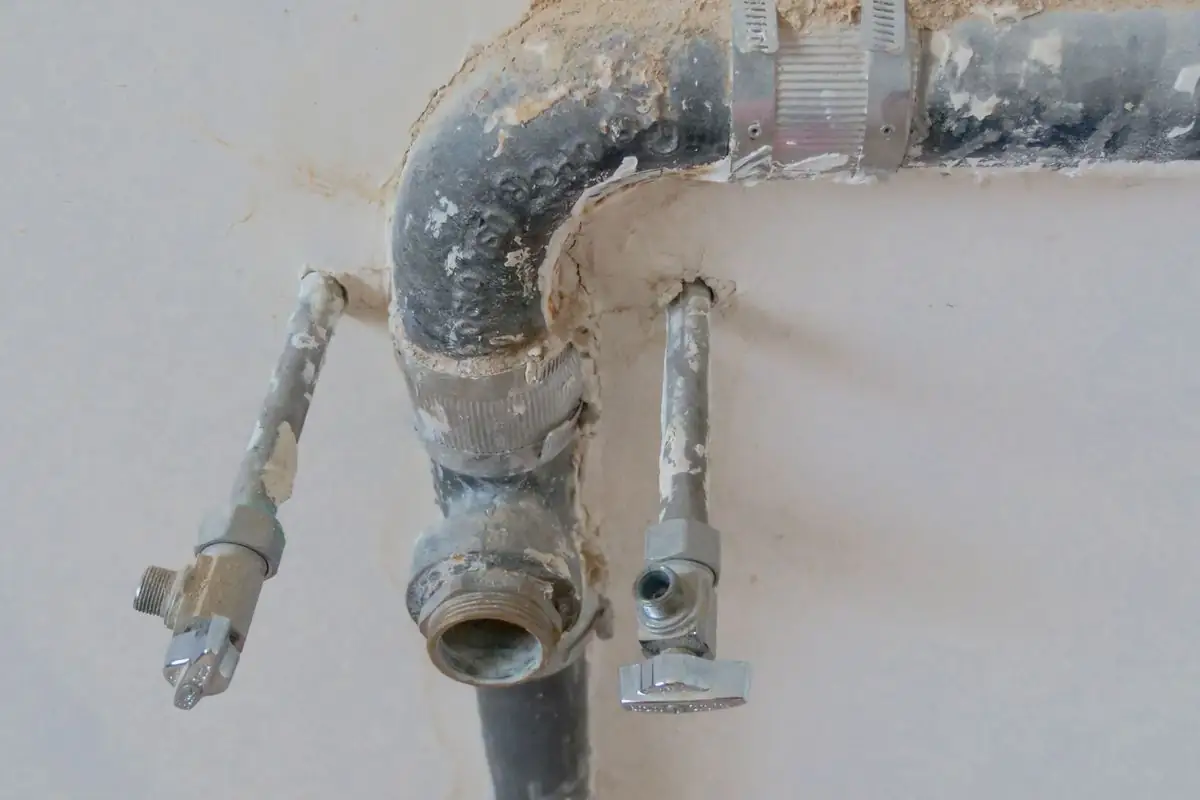
Where kitchen clogs actually sit
- On a typical two-storey Richmond Hill house from the 1990s, the kitchen drain leaves the cabinet as 1½-inch ABS, runs sideways through the floor joists and meets the stack in the basement ceiling. The worst build-up is almost always in that horizontal run, where water slows down and grease settles. The trap itself is rarely the problem.
- Double sinks with a dishwasher and a disposal add a second wrinkle: the continuous waste tee can be installed backwards or too low, so food from one bowl backs up into the other. We check that fitting every time.
How we clear it
- We remove the trap, look into the trap arm with a light and feed a 3/8 cable with a cutting head toward the stack. Once the cable passes the plug we work it back and forth to shave the walls, then run very hot water while the cable is still spinning so the softened fat goes downstream instead of re-settling.
- If the line plugs again within months, we put a camera in to check for a belly, which is a sag in the pipe where water sits. Bellies are common where a basement was finished and someone notched a joist or hung the pipe on a single strap.
Signs you need this
- Both bowls fill when only one is running
- Dishwasher leaves dirty water in the sink
- Gurgling from the sink when the washer upstairs drains
- A rancid smell from the cabinet
- Water backs up into a basement laundry tub
Keeping it open
- Scrape and paper-towel pans before they meet the sink, keep coffee grounds and eggshells out of the disposal, and run cold water with the disposal but hot water for a minute after dishes. Enzyme drain products are fine for upkeep; caustic crystals are hard on older metal traps and on the plumber who opens them later.
- If your sink sits on an island, tell us when you call. Island drains often use an air admittance valve under the cabinet, and a failed valve can make a clean drain behave like a clogged one.
How the job runs
- 1
Trap and continuous waste fittings are inspected under the cabinet.
- 2
The trap arm is opened and a cutting cable is run toward the stack.
- 3
Walls are scraped and the line is flushed hot behind the cable.
- 4
Dishwasher, disposal and both bowls are run together to confirm flow.
Richmond Hill note: most houses here sit on York Region municipal water with fairly hard supply, and many basements have a floor drain tied to the sanitary lateral. Mention both on the phone; it changes what goes on the truck.
Want a second opinion on your own pipes first? Dial (365) 363-1575; the person answering holds the wrench.